
Understand what your audience really sees.
Syno's Eye-Tracking Surveys use respondents' webcams to capture where they look when viewing your visual materials, adding attention-based behavioral data to your survey results.
- Built on Tobii technology
- Works on desktop and mobile
- Only after explicit respondent consent
Attention, captured through a webcam
Eye-tracking is a method that identifies where a person's gaze lands on a screen and how their attention moves across visual content.
With Syno's built-in solution based on Tobii technology, respondents use their computer or mobile webcam (after explicit consent) to view images, ads, packaging, or other on-screen materials. The system records gaze patterns during the viewing task and generates heat maps and attention metrics.
Ask for consent
Respondents must give explicit permission before the webcam is ever activated.
Show the material
Images, ads, packaging or any other on-screen material appears in the survey.
Record the gaze
Gaze patterns are captured during the viewing task, on desktop or mobile.
Get heat maps
The system generates heat maps and attention metrics alongside the survey answers.
Seen, skipped, or noticed first
Illustration of the output — your own heat maps come from your study.
The feature can provide insights such as:
- General areas that attract attention
- Sequence of viewing
- Approximate fixation points
- Heatmap-style visual summaries
These indicators help you understand which elements of your visual materials are being seen, skipped, noticed first, or focused on.
What to know before you run it
Works on desktop and mobile
Accuracy depends on lighting, webcam quality, and respondent stability
Respondents must provide explicit permission before activation
Fully compliant with standard privacy and data protection requirements
Behaviour, not just self-report
Eye-tracking adds a behavioral layer to traditional survey data, helping you understand real viewing behavior rather than relying only on self-reported answers. It is beneficial when evaluating how effectively key messages, visuals, or design elements are communicated.
Self-reported answers tell you what a respondent recalls and is willing to report.
Gaze data shows where attention actually went, in what order, and what got skipped.
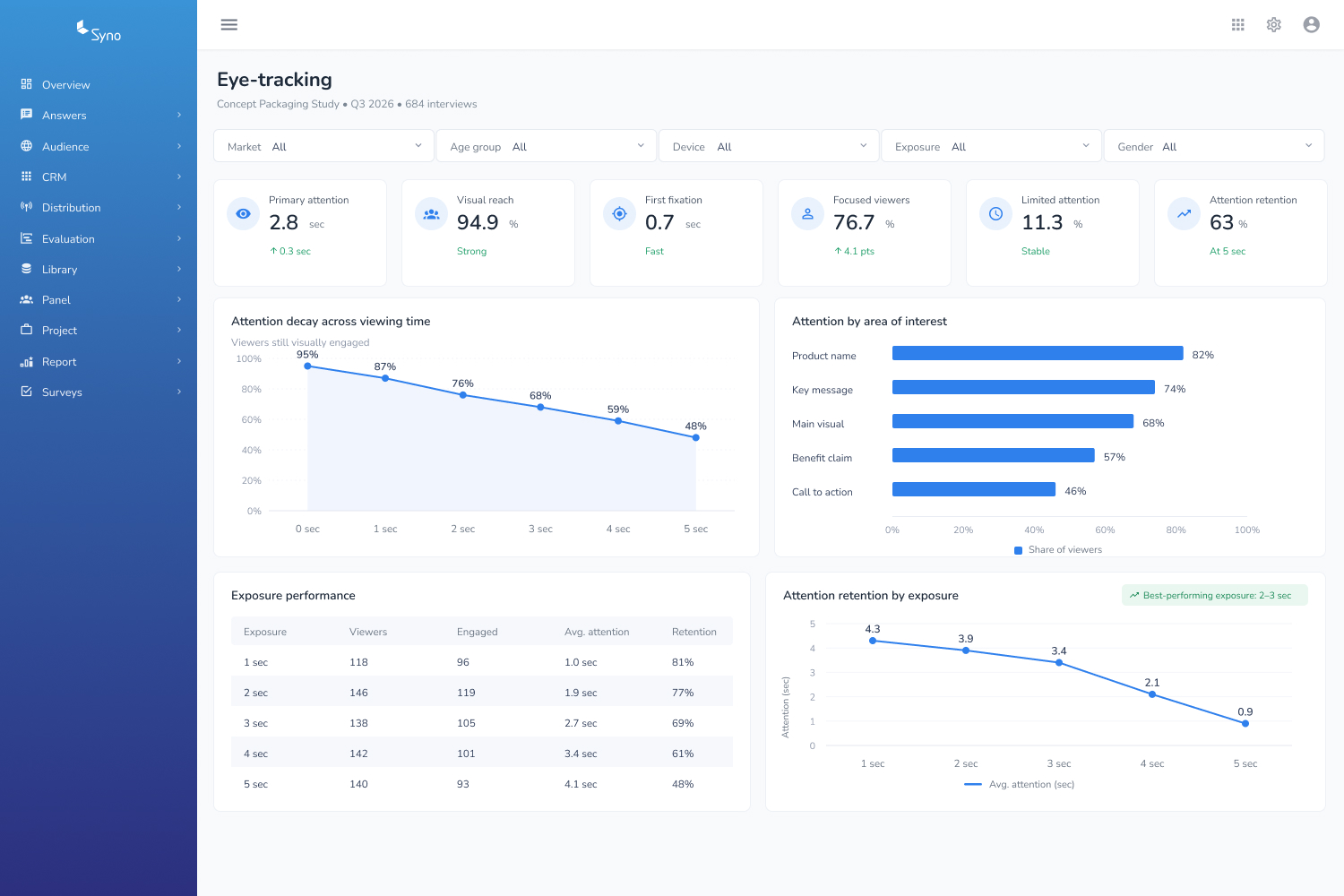
Where attention went, second by second.
Primary attention and first fixation alongside attention decay across viewing time and attention by area of interest.
Reach out to our team:
Are you interested in learning more about how Syno can help you with Eye Tracking Surveys?